卡萨布兰卡
2,200-year-old leaf-wrapped grain bundles found in Chinese tomb may be ancient precursor to ‘zongzi’_我的网站

一 |
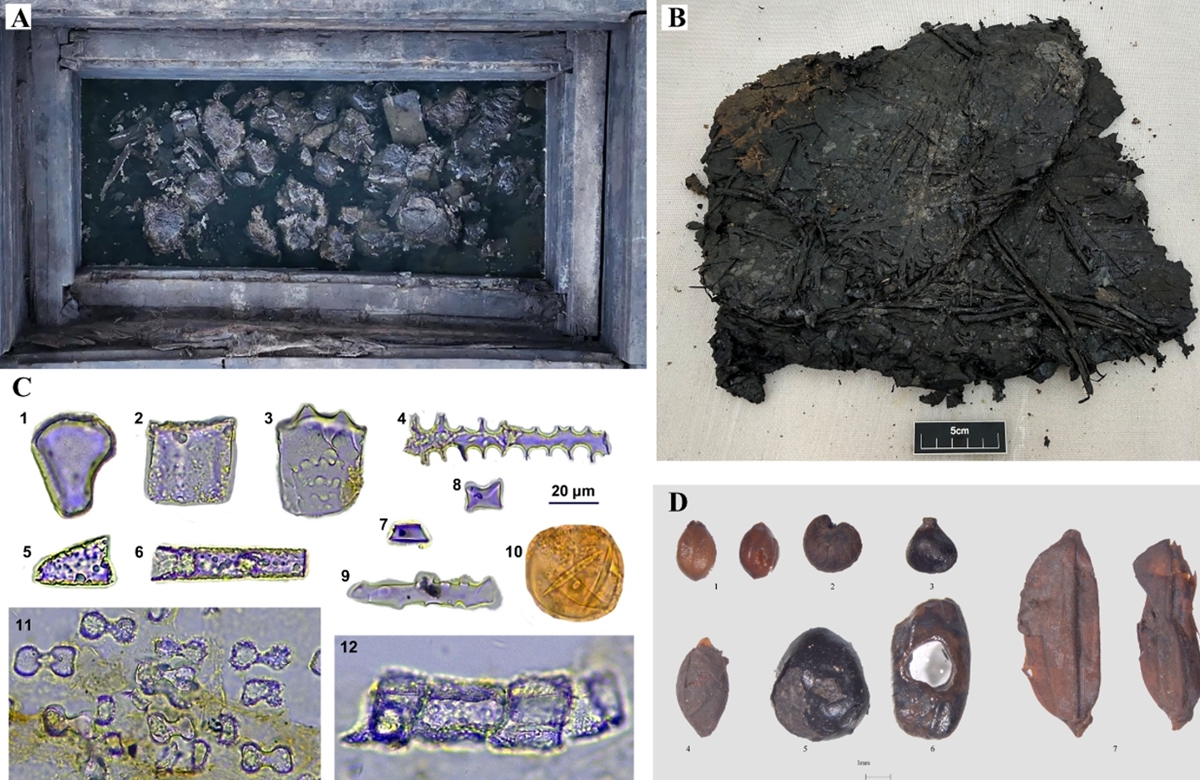
In March 2024, archaeologists from the National Center for Archaeology excavated a large number of well-preserved, waterlogged plant bundles from the tomb's outer coffin chamber. On-site, the plant bundles could be seen tightly wrapped in broad leaves and tied with plant-fiber cords.
A team of researchers led by the National Center for Archaeology, IVPP, and the Chinese Academy of Social Sciences examined 12 of the bundles and found that the wrapping leaves came from oak trees, while the cords were made from grasses.
The bundles mainly contained rice, broomcorn millet, foxtail millet, and cereal seeds, most of which were still in their husks and mixed with inflorescence material. Small amounts of peppercorn, mallow and rice-field weed seeds were also found.
The fact that the bundles were found in a tomb and mainly contained grains still in their husks suggests they were not everyday food, but offerings intended for funerary rituals. "This might reflect a Warring States-era belief that grains served as wealth for the dead in the underworld," Ge Yong, an associate researcher at the IVPP and the study's corresponding author, told the Global Times.
A Qin Dynasty (221BC-206BC) text describes a belief that "soybeans were gold and millet was money" for the dead, indicating that grains held symbolic significance in funerary culture. "The bundles therefore appear to have been ritual offerings prepared for the deceased," Ge said, "not food for the living."
The physical structure of the bundles also resembles that of zongzi, with grains wrapped in leaves and tightly secured with plant-fiber cords. "Similar practices of wrapping grains for burial have also been found elsewhere within the Chu cultural sphere," Ge said, "such as at the Chengyangcheng Site."
At the Chengyangcheng archaeological site in Henan Province, rice and broomcorn millet were also discovered wrapped in oak leaves. "An interesting fact is that we can still find zongzi wrapped with the same oak leaves now in regions related to the Chu cultural sphere."
"The findings suggest that wrapping grains as funerary offerings was a relatively common practice in the Chu state during the Warring States period," Ge said. "And this practice may have been an early form of the zongzi later associated with the legend of Qu Yuan."
These plant bundles share a structure similar to that of modern zongzi and to those described in legends and folklore. This might reflect how, through cultural exchange and heritage, these 2,200-year-old plant bundles likely evolved over centuries, shifting from sacrificial offerings to food, said Ge.
As diverse regional populations adapted the practice, it eventually transformed into the well-known Dragon Boat Festival tradition of eating zongzi. Thus, this structural resemblance might suggest a potential historical lineage; however, experts stressed that the Wuwangdun bundles should not simply be labelled as ancient zongzi.
"We can't define these plant bundles as the earliest zongzi, but rather, we can confirm that by 2,200 years ago at the latest, the Chu region had established a tradition of using this specific form of plant bundles for funeral rites. And this tradition could be a possible origin or precursor of the well-known zongzi," said Ge.
He added that the discovery provides critical physical evidence to explore the origins of zongzi and its cultural heritage.
。 Tel Aviv, Oct 11 (UNI) Israel has reached a historic agreement on maritime border demarcation with Lebanon, Prime Minister Yair Lapid said on Tuesday.
"This is a historic achievement that will bolster Israel's security, bring billions into the Israeli economy and bring stability to the northern border," Lapid said in a statement, as quoted by his office, adding that the deal will be submitted to the government for approval soon.
The office specified that the draft agreement "meets all the security and economic principles laid out by Israel" and it would be submitted for approval to the Security Cabinet and the government on Wednesday.
Lapid’s office specified that intensive negotiations through US mediator Amos Hochstein between Lebanon and the Israeli negotiating team led by National Security Council head Eyal Hulata took place over the weekend and the Sukkot holiday.
At the same time, Lebanon is also content with the agreement, as all of its demands have been taken into account, according to the office of Lebanese President Michel Aoun.
The negotiations on the demarcation of land and maritime borders between Lebanon and Israel have been taking place in Naqoura since 1996 on the basis of the memorandum of understanding under the UN auspices and the US mediation. In June 2022, Israel urged the Lebanese authorities to speed up the talks. It called the Karish gas field its strategic asset and assured Lebanon of the absence of plans to produce gas in the disputed territory.
UNI/SPUTNIK GNK。
Current article:http://weyu.zhaoliebengkuaiwaigeqi.bond/list_e0ymlq/391o.html
Published on:16:17:36


