美姐
Colombian writer’s new work brings home country closer to Chinese audience_我的网站

一 |
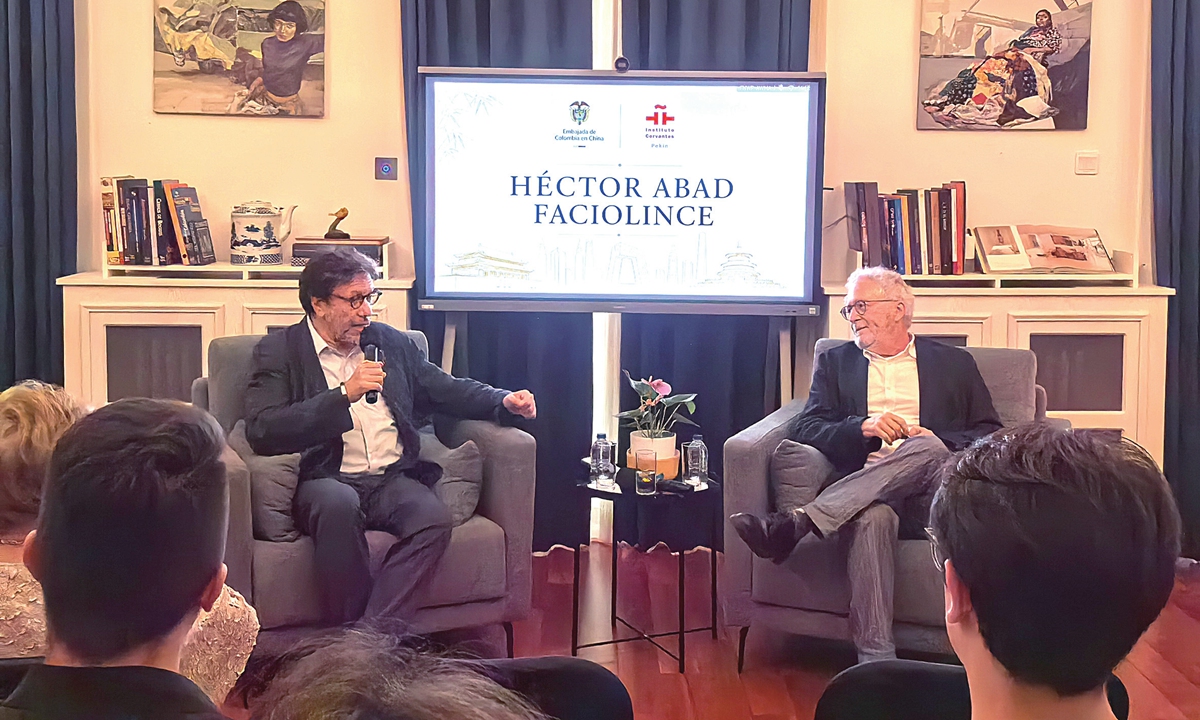
The Embassy of the Republic of Colombia in China hosted a colloquium with Héctor Abad Faciolince, a Colombian novelist, writer and journalist. The writer shared on Tuesday his growth journey from a journalist to achieve his dream as a writer, his observation of the Colombian society and his impression about the changes in China.
In a fully packed hall, Minister Plenipotentiary Jose Fernando Bermúdez Cendales said in his opening remarks that the event is part of an initiative to bring Colombian culture closer to the Chinese public while simultaneously creating new spaces for dialogue and exchange between the two countries.
Bermúdez said that Abad's visit to China offers a particularly valuable opportunity to showcase the richness of our literature and to strengthen the cultural and human bridges connecting Colombia and China.
The session, chaired by Santiago Gamboa, writer and minister counselor of the Colombian Embassy, focused on the career and body of work of Abad and in particular, El olvido que seremos (Oblivion: A Memoir).
Abad's book is a seminal work of contemporary Colombian literature in which personal and family memory engage deeply with Colombia's recent history. Its translation into Chinese allows this story to reach new readers and represents an extraordinary opportunity to bring both societies closer together through literature, per some commentators.
"We hope this gathering will be an open conversation among cultures, readers, and experiences, and a new expression of the friendship that Colombia and China continue to build," said Bermúdez.
Abad, one of the most important voices in contemporary Latin American literature, shared with the Global Times that this is his second trip in China. The last time he visited the country was two decades ago.
This time, in his eyes, China has changed a lot. In many ways, the country stands for the future of the world.
Abad said he is surprised to see how much Chinese people are depending on the electric devices and network to communicate in a virtual world, and said that he felt "like an alien."
Talking about his interaction with readers in Shanghai, Abad smiled, saying that the readers selected some phrases from his book and asked him to write down as part of the autography and signature for them.
In his book, El Olvido Que Seremos (The Oblivion We Will Be), which is acclaimed as a "love letter from a son to his father," is not only a deeply affectionate look back at familial bonds but also a courageous attempt to defy oblivion.
Rooted in true events, The Oblivion We Will Be chronicles the life of his own father. Abad noted that his father was killed in August 1987 - nearly forty years ago.
In the Western literary tradition, a father is often portrayed as a distant or even negative figure. His father, however, was "totally different - a man of love and deep sense of responsibility in both the public sphere and his family life."
Such image of a benevolent, non-authoritarian father has impressed his Chinese readers as well, he said.
As a physician, Abad's father dedicated his life to addressing fundamental issues affecting people's well-being, such as drinking water quality and public health, steadfast in the belief that the world could be made better through action.
Abad's work addresses themes such as memory, violence, inequality, and the human condition, deeply marked by the murder of his father, an event that inspired his most iconic book, The Oblivion We Will Be was published in Chinese by Writer's Publishing House in Beijing in July.
。 8月初,西南野生菌进入上市高峰,松茸、鸡枞、牛肝菌等30多种“山珍”大量到货,迎来性价比最高的“黄金赏味期”。

二 | 有消费者发现,部分云南野生菌餐厅有一道特殊流程:服务员把菌汤锅盖锁住,钥匙带走,煮够时间才开锁。 因为锅里煮了见手青——一类牛肝菌的统称,其中不乏有毒品种,未煮熟会致幻中毒,过去此类报道屡见不鲜。有餐馆甚至不让打包带走,或要求签免责协议。 煮够时间就绝对安全了吗?见手青到底有多毒?来看专家介绍。 中国科学院昆明植物研究所研究员杨祝良介绍,这类菌子属于“条件可食用真菌”,但他也提醒,烹饪时要特别注意煮熟炒透。

三 | 此外,他还强调,要特别注意当见手青菜品被放凉后,毒素会恢复。

四 | 比如剩菜放冰箱过夜,第二天用微波炉热一分钟就吃,这时候最容易中毒。 而对于有些菌子中的毒素来说,高温烹饪并不能去除其毒素,需高度警惕。 杨祝良:比如鹅膏菌含的环肽类毒素,厨房里常规的煎炒烹炸、甚至用高压锅压一个上午,都破坏不了它。高温、强酸、强碱都拿它没办法,毒素始终留在汤里,吃下去照样对人造成极大危害。

五 | 所以这类剧毒蘑菇,必须高度重视。 专家介绍,“见手青”类牛肝菌在被撕裂后会由白色、黄色快速转变为青色,也因此有了“见手青”的名字。但是,变青、变蓝并不是它有毒的一种体现,和它有毒并没有关系。 关于如何识别菌子是否有毒,在网络上有些说法流传很广,比如“颜色朴素=安全”“有虫子去吃它的就无毒”“用银器可以试毒”等等。对于这些,杨祝良表示,并不靠谱。 杨祝良:民间流传的验毒方法大多不靠谱。银器试毒不可行——所有剧毒蘑菇都不会让银变黑。

六 | 虫吃过的蘑菇也不一定安全,有些剧毒蘑菇蜗牛、虫子吃了没事,因为它们不吸收毒素,但人吃了完全不同。至于“鲜艳的蘑菇有毒,朴素的蘑菇无毒”这种说法更是危险,剧毒的鹅膏外表就很朴素,成年人吃一个就足以致命。 云南、川渝、华南地区等等,各地有关机构常会制作本地毒蘑菇图鉴。但非专业人士看着仍旧有点“脸盲”。其实,并不能把这些图鉴中无毒的部分当作“菜谱”来用。杨祝良表示,这些图鉴主要是起到一个提醒作用,让大家重视。 杨祝良:要从众多野生蘑菇中分辨出哪些能吃,其实非常困难。除了专门从事这方面研究的专家,普通人真的很难辨别。所以,千万不要轻易尝试自己不熟知的蘑菇。 (中央广播电视总台中国之声)。
Current article:http://weyu.zhaoliebengkuaiwaigeqi.bond/4oilu5g/20260826/4212122.html
Published on:05:42:04